
New Lab Member / An Interview with Dr. Şükriye Bilir – In Footsteps of RNA
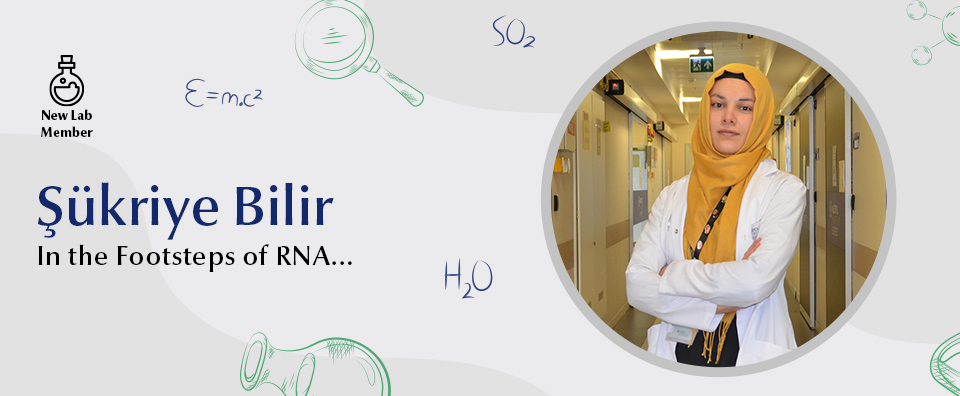
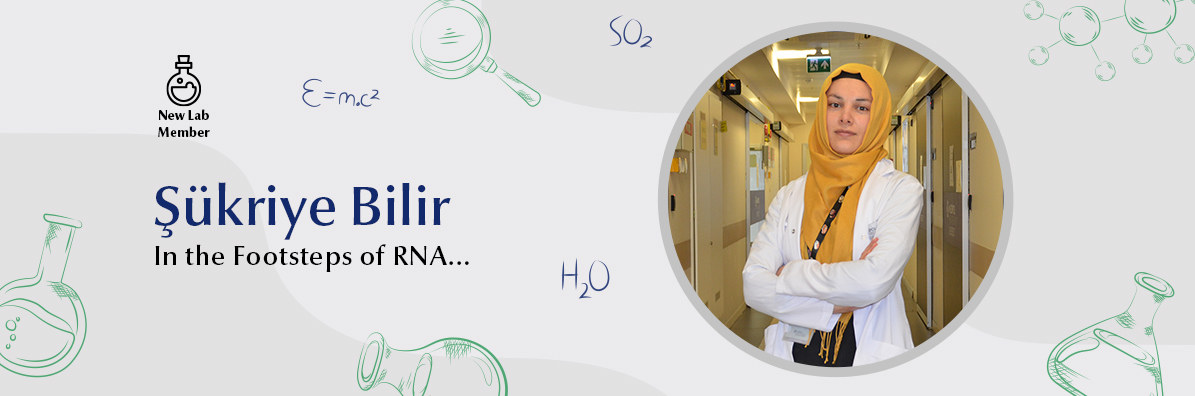
‘’I Was in Love with Learning’’: An Interview with Şükriye Bilir on Academic Life and Science
Dr. Şükriye Bilir, took her B.Sc. degree from Istanbul Technical University, Molecular Biology and Genetics department in 2013. After graduation she has started her postgraduate education in Osaka University, Graduate School of Frontier Biosciences. During her graduate education, she developed a deep interest towards complicated and specific high-resolution microscopic techniques. After graduation she has started as a postdoctoral researcher in Sabancı University and it has been fallowed with Koç University. Her last stop now is İstanbul Medipol University SABITA as a postdoctoral scientist. She is also interested in RNA metabolism especially on neurodegenerative and neuro-muscular diseases, and crop yield mechanisms. Her lifetime aim is to be able to develop new and easy techniques for the visualization of RNA molecules on living organisms which will help to understand the RNA metabolism thoroughly and detailly.
As SABITA (Health Sciences and Technology Research Institute) research center, we interviewed Şükriye Bilir on her academic career life, experiences and science. We would like to thank her for sharing her valuable experiences and knowledge with us.
How long have you been involved with science? How and when did your interest in science and research begin?
I should say that I am professionally involved with science by the start of my postgraduate education which makes approximately 8 years up to now. My interest with science has started during elementary school years of mine. I was always a talented kid on math, physics, biology and I was in love with learning. I guess I have decided to be a scientist during those times when I was around 11 years old. Of course, I was a kid that time and had curiosity on everything, but with the help of my teachers during my high school years I have decided on molecular biology. And for the research interest I should say that during my B.Sc. and Ph.D., it had changed a lot. During my BSc. Degree I was interested in with protein structure, biotechnology and also microscopy. I had experience with all three areas and microscopy was the area which made me most excited. So, my Ph.D. work was in a microscopy lab in Osaka University under the supervision of Prof. Yasushi Hiraoka and Prof. Tokuko Haraguchi. Even though I am really into microscopy techniques, to use these techniques on the discovery of cellular mechanisms makes me feel the joy and the enthusiasms on the top level. I had and still have interest on RNA metabolisms. My interest on RNAs have started during my Ph.D. with a small work I have done with RNA regulating proteins. My main research during my Ph.D. was about the nuclear pore complexes and it is known that RNA transport mechanisms through nuclear pore complexes creates huge epigenetic differences on protein expressions. During my postdoctoral research experience on Sabancı University and Koç University too, I mostly worked with microRNAs which are small RNA molecules regulating the gene expression. I guess I should summarize that my current interest has been created by my experience. RNA molecules make me feel excited and there are lots of things unknown about their role on cellular processes and also diseases.
What are the primary and secondary responsibilities of postdoctoral position?
For me the main responsibilities of postdoctoral position are to be productive as much as possible, to create new ideas and make new discoveries. Accordingly, primary responsibilities must be to do research of their own design and ideas or the ideas of their mentor. Secondarily it must be to educate and mentor young fellows and students.
Do you have a specific project from your ongoing work and how does your project preparation process work?
As I have mentioned before I have interest on all RNA related cellular processes. Currently I am in the preparation of two different projects to define the role of different types of RNAs. First one is about the RNA molecules which may be important for the regulation of muscle formation mechanisms eventually is related with the muscular dystrophies. The second project is about to discovery of new non-coding RNA molecules which may affect the crop yield on relation with iron deficiency mechanisms on plants. Currently enjoying a lot when writing these projects, and I will submit them so soon. Looking forward to hear the results of these grant applications.
What are the main challenges associated with this position?
Main challenge should be to be responsible of your all act towards your projects, I guess. I do see it as a self-improving challenge to tell the truth. Before, on Ph.D. or postdoctoral educations, projects are not owned by you even though you give your everything to do the job, the main responsibility if the research fails are on the supervisor. Now since you are the creator of your projects you are the one responsible of everything. Even though it is a challenge, it is necessary to improve ourselves on the way of academic life.
‘’Know Yourself and Do What You Like and Love Instead of Forcing Yourself to Do Something That You Do Not Want’’
Why did you continue with the academy, why should we prefer the academic process? What is your advice to those who are afraid? Because I have always loved to learn and discover, I have decided to go on in academia. This was a decision made in childhood years. I am sure all jobs have their challenges and struggles, but it is had to be known that, if you are not enthusiastic enough, you won’t be able to survive in academia. Important thing here is to know yourself and to do what you like and love instead of forcing yourself to do something that you don’t want.
What have you done for your career development or to improve yourself? / How does it contribute to your postdoc career development?
I have done what is necessary to be done. For career development I guess, the most important thing should be to read. When you read enough you will see the flashlights on your brain. Your brain will help you to create new ideas in an interesting way by joining unrelated information in similar subjects. Of course, second important thing is to have real physical experience. If you are a young scientist or a student don’t be afraid on jumping into all opportunities. During my Ph.D. and also postdoctoral educations I had worked with multiple molecular biology techniques in multiple different projects including lots of different diseases and cellular processes, which I believe helped me a lot to learn the detailed insights of the laboratory techniques and also cellular processes.
How did you decide to do your master’s and postgraduate in Osaka?
In my BSc. degree since I was interested in microscopy techniques, I took some extra optic related classes from physical engineering department in İstanbul Technical University. During my last year, I have decided to go on in microscopy. I at least wanted to use microscopy techniques to discover cellular phenomena. For this reason, I have started to contact with microscopy working laboratories. Because I thought that, they are more safer countries, I have contacted with professors from Japan and also from Canada. The professors from Japan were extremely interested in with me and they represented lots of scholarship opportunities. Because of this reason I have decided to go on with Osaka University.
What are the requirements for doing master’s and postgraduate abroad and what are the qualifications generally desired?
To have postgraduate education abroad, you need to have a good transcript with a high GPA. Secondly, they ask about your language abilities. If you have these two, a high GPA and a good level of language abilities with proofs, only thing is to convince your supervisor to be ‘how you are keen on and devoted to that specific research area’. It is totally up to the professor you apply, to accept you as a postgraduate in their lab.
What are the positive and negative aspects of studying in Japan? How did it feel to be away while studying there? How was your adaptation to the country? Can you briefly talk about your experiences there?
It was a really enjoyable and peaceful experience for me to be in Japan. Positive aspects are surely to have the opportunity to work with leading scientists, to be introduced to the world scientist pool. I had lots of connections from different parts of the world which will be future collaborations for research. I have not only learnt a lot about science, but also about life there too. The tolerance and harmony understandings of Japanese culture have affected me mostly. I have seen there how a country can develop quickly and powerfully when they focus on the similarities instead of focusing on differences. They know how to live together for the benefit of their own country by respecting each other.
For the negative aspects I can give examples about being in a different unknown environment. The food there is really not the food that I got used to here in Turkey. I have struggled a lot about it, but I have also discovered delicious new tastes too. Second example can be the language barrier. Lots of Japanese people cannot speak or understand English, so you have to learn Japanese to find your way. Luckily, I had some initial attempts in İstanbul Technical University to learn Japanese. In our ITU language school, we were able to take Japanese courses for free which helped me a lot. Because as you see I was ready to be in Japan, it was not scary at all. I totally enjoyed my journey in Japan. And happy to meet with all those people.
What are the challenges of the academic career process? Have you ever thought about giving up?
Academia is not easy, so I have though multiple times to give up. Even though they are not so serious ideas, I won’t lie that they passed through my mind multiple times. You are in a competition with the scientists from all over the world to be the first one to discover or publish a phenomena. Since your competitors are also unknown, in an unknown place, in an unknown progress, this competition creates a stress with lots of pressure. There were times that I thought, I may be happier if I sell flowers on the streets instead of dealing with this pressure. But anyway, I always do clear up my mind about how I love science and how much I do enjoy to discover. Instead of focusing on to the competition, I do focus on my love in life ‘the science’ which helps and helped me to get rid of the stress.
Are you satisfied with your current position? What are the things you want to do in the future?
I am currently so much happy about my position. As a scientist in the start of her career, to have the opportunity to be apply for my own grants, to be able to work in a laboratory with world class equipment makes me feel lucky. I will do my best to use these opportunities in SABITA properly and to the full. This will be a really good and beneficial experience for me to be able to work here and huge step for my academic career. I want to work here in SABİTA until I feel satisfied about my achievements about published papers and new discoveries. After that I want to climb the stairs of academic life, by starting my own laboratory and so on.