

Headline / The Nobel Prize – in Physiology or Medicine
2021 NOBEL PRIZE IN PHYSIOLOGY OR MEDICINE
“How are temperature and mechanical stimuli converted into electrical impulses in the nervous system?”
How do we perceive the warmth of the sun, the breeze of the wind, and the fragrant flowers? Our perception of the environment with our senses has been a matter of curiosity for centuries and some studies are done.
In the 1880s, distinct sensory spots on the skin were shown to react to specific stimuli, such as touch, heat or cold, indicating that different stimuli activate different types of nerves. In 1906, Camillo Golgi and Santiago Ramón y Cajal received the Nobel Prize for their work on the structure of the nervous system, which included an anatomical description of the somatosensory system. Sir Charles Sherrington and Edgar Adrian received the Nobel Prize in 1932 for their discoveries regarding the function of neurons, including a description of somatosensory neurons. In 1944, Joseph Erlanger and Herbert Spencer Gasser received the Nobel Prize for their discoveries related to the differentiated functions of single somatosensory nerve fibers. These discoveries established important principles for the propagation of action potentials along skin and muscle sensory nerve fibers.
Despite these studies, the most fundamental question still waits for its answer is this: What was the structure of molecules that sense heat and mechanical stimuli, and in what ways do these molecules cause electrical signals to emerge? Two scientist who were awarded Julius and Patapoutian answered this fundamental question, thanks to the work done.
Two scientists who were awarded the Nobel Prize in October 2021 found the answer to this question by discovering the temperature and touch receptors. Dear scientists; David Julius from the University of California San Francisco (UCSF) and Ardem Patapoutian of Scripps Research. David Julius utilized capsaicin, a pungent compound from chili peppers that induces a burning sensation, to identify a sensor in the nerve endings of the skin that responds to heat. Ardem Patapoutian used pressure-sensitive cells to discover a novel class of sensors that respond to mechanical stimuli in the skin and internal organs.
Temperature Receptors
David Julius and his team played an important role in the discovery of transient receptor potential (TRP) channels, a diverse family of channels that respond to a wide range of chemical and physical stimuli.
Julius and coworkers made a cDNA library from rodent dorsal root ganglia that contain the cell bodies of the capsaicin-activated sensory neurons. Capsaicin-insensitive cells were transfected with batches of these cDNAs and eventually a single cDNA clone was isolated that could confer responsiveness to capsaicin. The isolated gene was predicted to encode an integral membrane protein with six transmembrane domains and a homology search revealed that it belonged to the superfamily of transient receptor potential (TRP) cation channels.
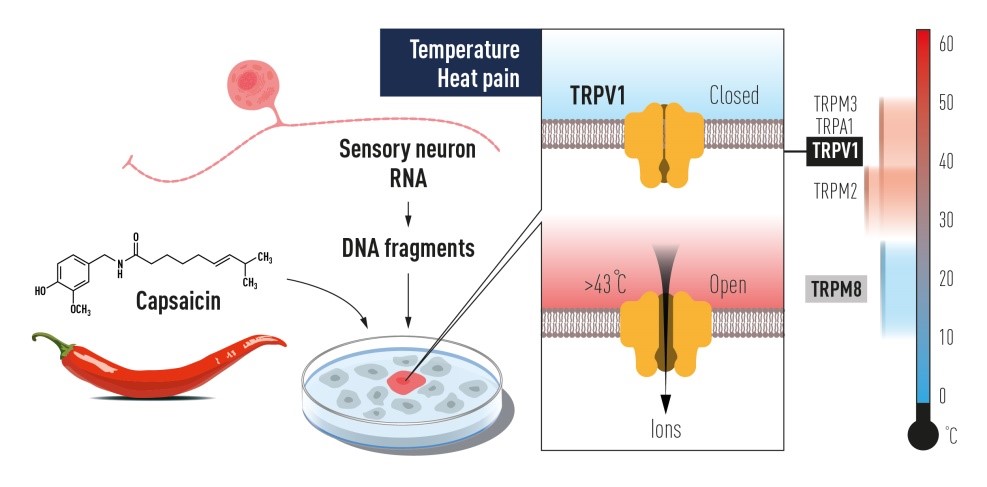
Figure 1: David Julius used capsaicin from chili peppers to identify TRPV1, an ion channel activated by painful heat.
Additional related ion channels were identified and we now understand how different temperatures can induce electrical signals in the nervous system.
Julius continued to functionally characterize the TRPV1 receptor by ectopic expression in cells and found that the capsaicinevoked electrophysiological properties resembled those of channels found in native sensory neurons. While exploring the physiology of TRPV1, Julius examined its sensitivity to elevated temperature and found a pronounced activation by heat leading to cellular Ca2+ influx. Direct measurement of currents using patch-clamp recordings revealed a specific heat-evoked membrane current with properties similar to those of sensory neurons. Shortly after identifying TRPV1, Julius showed that in the absence of other factors, heat directly activates this channel and acts as a molecular integrator of painful heat stimuli and chemical stimuli.
The structural studies of TRPV1 channels have provided important insights into mechanisms for their ion permeation, ligand recognition and gating, but the mechanisms for their activation by heat are not fully understood at the structural level.
Touch Reseptors
Ardem Patapoutian and his team contributed significantly to our understanding of how mechanical stimuli are converted into electrical or chemical signals via a mechanically activated ion channel. His team determined multiple families of mechanoreceptors, such as PIEZO and OSCA/TMEM63, that play a critical role in signal transduction, including the touch sensation and sensing the mechenical signals that regulate blood vessels and airways.
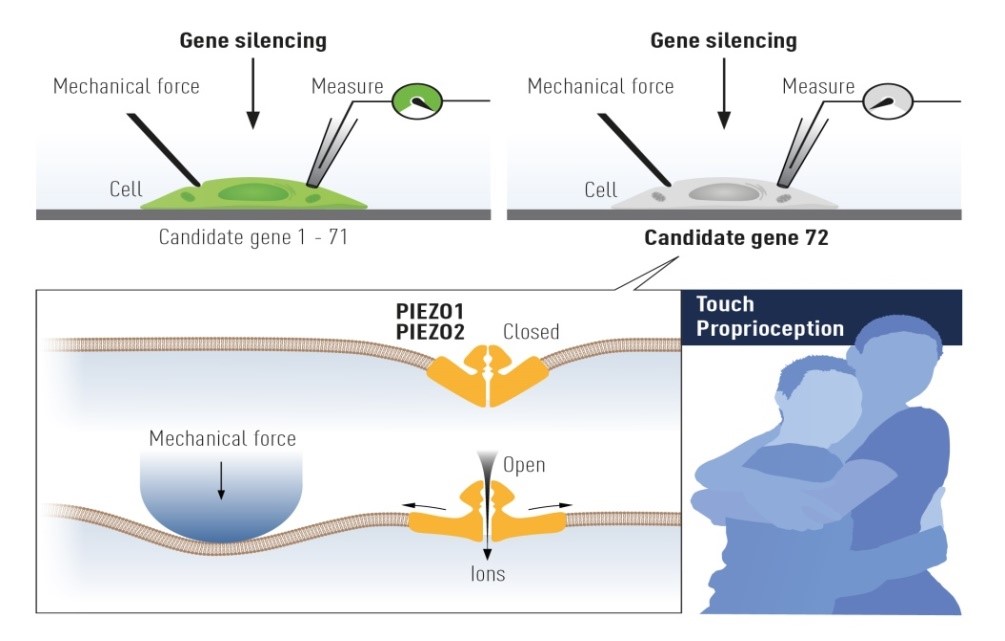
Figure 2: Patapoutian used cultured mechanosensitive cells to identify ion channels activated by mechanical force.
After painstaking work, Piezo1 was identified. Based on its similarity to Piezo1, a second ion channel was found (Piezo2).
Ardem Patapoutian of Scripps Research, California, developed a new scanning approach to explore mechanosensation in mammals. Along with postdoctoral researcher Bertrand Coste, he described an intrinsically mechanosensitive cell line called Neuro2A.
Patapoutian performed global expression analysis and identified 72 candidate genes predicted to encode proteins with at least two membrane-spanning domains, which included known ion channels and proteins of unknown function. The candidate genes were silenced oneby-one by RNA interference and the transfected cells were tested to determine whether the application of mechanical force resulted in a current that could be recorded using patch-clamp.
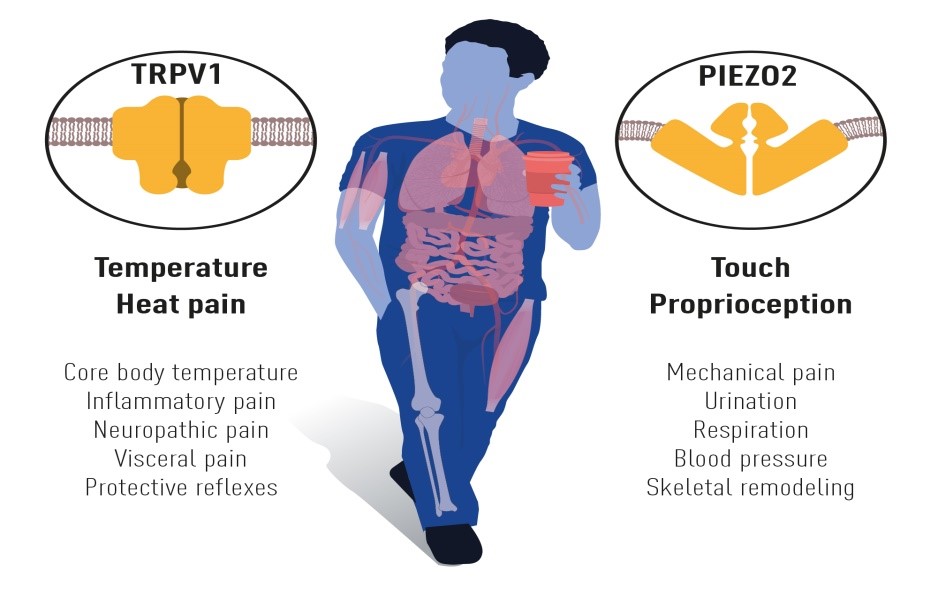
Figure 3 The seminal discoveries by this year’s Nobel Laureates have explained how heat, cold and touch can initiate signals in our nervous system. The identified ion channels are important for many physiological processes and disease conditions.
Knockdown of the last gene on the list, formerly known as FAM38A, abolished the mechanically activated current. The corresponding protein was named PIEZO1, from the Greek word “piesi” meaning pressure. Patapoutian went on to show that ectopic expression of PIEZO1 mechanically sensitizes human embryonic kidney cells (HEK-293) because pressure applied to the plasma membrane induces a large current in these cells. A second mechanosensitive channel, named PIEZO2, was later discovered by sequence homology. The newly identified PIEZO channels belonged to a previously unknown family of proteins found in vertebrates and many other eukaryotes. The groundbreaking discovery of PIEZO proteins as excitatory ion channels directly gated by mechanical force has revolutionized the field of neuroscience by providing a molecular basis for mechanosensation.
Through their mechanosensitivity, PIEZO channels serve as versatile mechanotransducers in many cell types and convert mechanical force into electrochemical signals. However, the exact mechanisms whereby mechanical force opens the central pore are still not completely understood.
Intensive ongoing research, thanks to this year’s Nobel Prize-winning discoveries, focuses on elucidating their functions in a variety of physiological processes.This knowledge is used to develop more effective treatments for a wide variety of disease conditions. It is also used for chronic pain.
REFERENCES:
- Nobel Prize Committee (2021) Press release: The Nobel Prize in Physiology or Medicine 2021. In, https://www.nobelprize.org/prizes/medicine/2021/press-release/. Accessed 8 Dec 2021.
- Miglis, M.G., Larsen, N. & Muppidi, S. The 2021 Nobel Prize in Medicine and its relevance to autonomic medicine—and other updates on recent autonomic research. Clin Auton Res31, 655–658 (2021).
- Kefauver JM, Ward AB, Patapoutian A (2020) Discoveries in structure and physiology of mechanically activated ion channels. Nature 587:567–576.
- Zeng WZ, Marshall KL, Min S, Daou I, Chapleau MW, Abboud FM, Liberles SD, Patapoutian A (2018) PIEZOs mediate neuronal sensing of blood pressure and the baroreceptor reflex. Science 362:464–467.
- Nobel Prize Committee (2021) Advanced İnformation: The Nobel Prize in Physiology or Medicine 2021. In, https://www.nobelprize.org/prizes/medicine/2021/advanced-information/. Accessed 15 Dec 2021.