

REMER Talks / Computational Assessment of Trimethoprim Resistance in Dihydrofolate ReductaseREMER Talks / Computational Assessment of Trimethoprim Resistance in Dihydrofolate ReductaseREMER Talks / Computational Assessment of Trimethoprim Resistance in Dihydrofolate ReductaseREMER Talks / Computational Assessment of Trimethoprim Resistance in Dihydrofolate Reductase
  • RESEARCH CENTERS
  • CORE FACILITIES
    • Advanced Microscopy
    • Cell Culture
    • Molecular Cell Biology
    • Proteomics
    • Drug Discovery
    • Bioinformatics
    • Biomaterials
    • Electrophysiology and Behavior
    • Cognitive Neuroscience
    • Animal House
  • PEOPLE
    • Administration
    • Group Leader
    • Transition Scientist
    • Early Career Researchers
    • Students
  • EVENTS
    • Event Calendar
    • Critical Mind
    • SABITALKS
    • InFocus
    • CROSSTALKS
    • MODAS WS
    • SABITA Podcast
    • Social
  • ABOUT US
    • Our Mission
    • Gender Equality Policy
  • RESEARCH CENTERS
  • CORE FACILITIES
    • Advanced Microscopy
    • Cell Culture
    • Molecular Cell Biology
    • Proteomics
    • Drug Discovery
    • Bioinformatics
    • Biomaterials
    • Electrophysiology and Behavior
    • Cognitive Neuroscience
    • Animal House
  • PEOPLE
    • Administration
    • Group Leader
    • Transition Scientist
    • Early Career Researchers
    • Students
  • EVENTS
    • Event Calendar
    • Critical Mind
    • SABITALKS
    • InFocus
    • CROSSTALKS
    • MODAS WS
    • SABITA Podcast
    • Social
  • ABOUT US
    • Our Mission
    • Gender Equality Policy

REMER Talks / Computational Assessment of Trimethoprim Resistance in Dihydrofolate Reductase
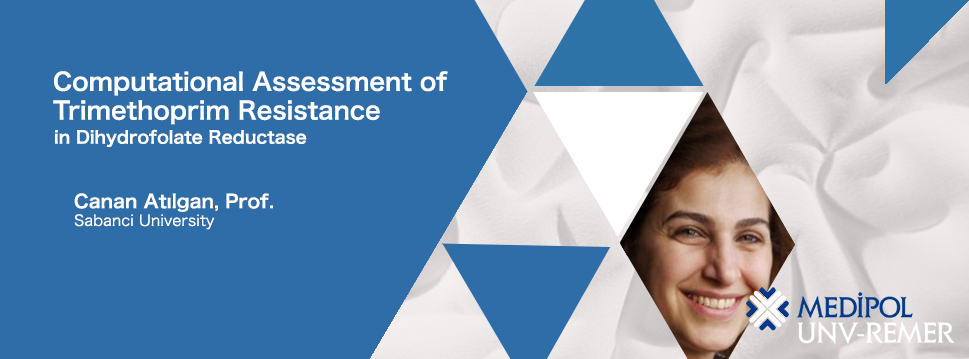
 

We characterize structural and dynamical changes induced ondihydrofolate reductase (DHFR). We investigate the structural features of the mutant protein that allow it to survive natural selection. Mutants detected under selection pressure induced by the antibiotic trimethoprim (TMP) are studied. We investigate the structural features of DHFR that lead to catalytic activity while simultaneously casting out TMP. Binding constant and catalytic activity measurements on different mutants provide conflicting results, implying alternative routes towards conferring drug resistance. We execute extensive molecular dynamics simulations and alchemical free energy perturbation calculations for the mutants in their folate or TMP bound conformations. The competing effects of dynamics and thermodynamics in the mutants are assessed through a combination of these approaches.

Dr. Atilgan is part of the MIDST group at Sabancı University (http://midst.sabanciuniv.edu/). She received her PhD from Boğaziçi
University Chemical Engineering Department in 1996. She has done postdoctoral research at the Supercomputer Computations Research Institute of Florida State University (1996-1999) before joining the Faculty of Engineering and Natural Sciences of Sabancı University (1999 – ). She is a member of the Science Academy, the recipient of TÜBİTAK Incentive Award (2002), TÜBA Distinguished Young Scholar Award (2004) and L’Oréal Turkey for Women in Science Award (2005). Her research efforts are directed towards the physics- based modeling of soft matter at multiple time and length scales. Her group has studied conformational multiplicity, self-assembly, and reactivity of various molecular systems, including proteins, drug molecules, cyclic peptides, polymers, di- and tri-block oligomers using computational tools at the atomistic and coarse-grained levels.

Share

SOCIAL MEDIA

SHORTCUT LINKS


  • Contact
  • Corporate Identity
  • Referrence Guide
  • Request Forms
  • Sabita 360°
  • Sabita Society
  • Social

OUR MISSION

Translation of Scientific Findings From Bench to Bedside

  • Read More
  • © 2025 Medipol University | SABITA Research Institute for Health Sciences and Technologies
    [contact-form-7 id="50" title="Contact form 1"]